
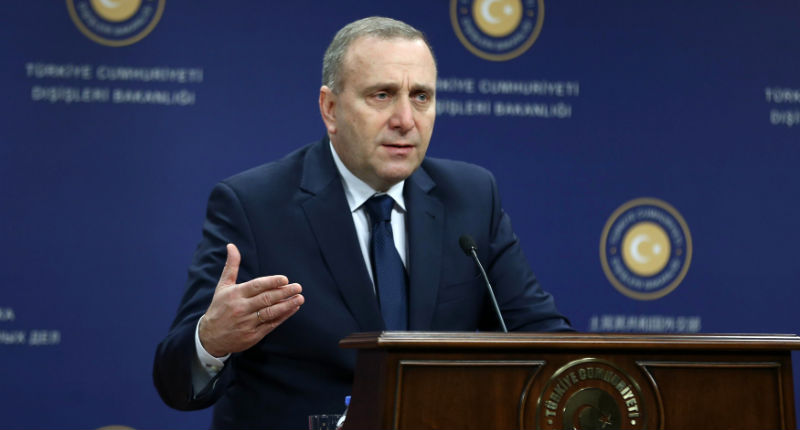

Poland’s Minister of Foreign Affairs, Grzegorz Schetyna has raised hopes that the Eastern Partnership summit will bring about changes in the EU’s visa policy for its members.
The comment comes as EU leaders gather in the Latvian capital of Riga to meet their counterparts from the six Eastern Partnership countries, namely Armenia, Azerbaijan, Belarus, Georgia, Moldova, and Ukraine.
In a statement published on the Twitter social media network, the Polish Foreign Ministry cites Schetyna as saying that “The Riga summit is another milestone for the Eastern Partnership project”.
“We should make sure that it brings the [Eastern Partnership] countries closer to the EU, especially in the human dimension, by abolishing visas or liberalising the visa regime,” Schetyna said.
Schetyna’s comment comes off the back of a trip to the Georgian capital of Tbilisi in mid-April, where he voiced support for the country’s European aspirations.
In an op-ed published by thenews.pl last week, Georgia’s Foreign Minister Tamar Beruchashvili also wrote that “We must make sure [the Riga summit] delivers a strong message of joint commitment to the European future of our region, and backs this up with concrete measures to realise this vision.”
“The progress towards visa liberalisation for Georgia will be an important part of the picture,” Beruchashvili added.
According to the European Council, the summit – the fourth of its kind, and the first since the escalation of the Ukraine crisis last year – is to “demonstrate [the] EU’s determination to pursue closer, differentiated relations with its independent and sovereign [Eastern Partnership] partners”.
Not so fast…
However, the drafting of the final declaration of the Eastern Partnership summit has caused headaches for both Tbilisi and Kiev, which both wanted a relaxing of EU rules on visas.
While the final document is expected to include statements on the European aspirations of Georgia, Ukraine and Moldova – which have all signed Association Agreements with the EU – not all member states were keen to recognise those countries’ ambitions in a debate earlier this week.
France, Germany, the Netherlands and Italy were the most vocal opponents of the statement, declaring that they wanted no suggestion of any European perspective for the three countries.
While the document is set to contain such a statement after all, the visa question has been put on hold, with a relaxation of restrictions once prerequisite conditions have been fulfilled.
Aftermath of Ukraine crisis
The Ukraine crisis, which erupted after the last Eastern Partnership summit in Vilnius towards the end of 2013, has also dampened initial enthusiasm.
“The Ukraine crisis has cast a shadow on the Eastern Partnership, [and] there needs to be a new incentive for this idea,” Pierre Viemont, a former diplomat and expert at the Carnegie Europe think-tank told Polish Radio.
Meanwhile, Eastern Partnership members Armenia and Belarus have also raised doubts as to an annexe to the final declaration which is to criticise Russia for annexing Crimea.
However, a source close to the EU delegation told the AFP news agency that “this is not a real threat to the summit”, meaning that the annexe will most likely concentrate on the respect of territorial integrity of each Eastern Partnership country.
The full text of the declaration is set to be announced on Thursday evening once the summit gets under way. The meeting ends tomorrow, Friday.
