
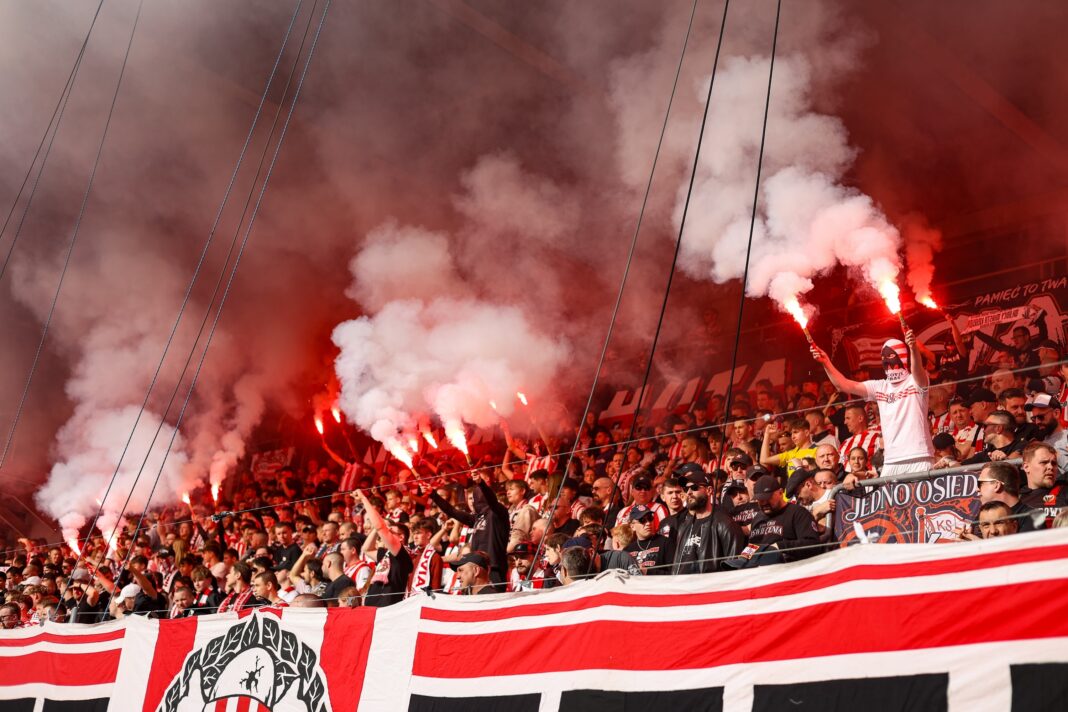

Autumn 2025 offered Cracovia something rare in recent history: proximity to greatness. Not a distant dream, not a theoretical calculation, but a tangible sporting reality. After 18 rounds of the season, the Kraków side found itself just three points behind the league leaders. In a league as compressed and volatile as the Ekstraklasa, that margin is not a gap – it is an invitation.
Yet as winter arrived, that invitation remained unanswered. Instead of momentum, Cracovia entered the break with questions. Instead of reinforcement, uncertainty. And instead of football, the club became consumed by boardroom upheaval.
Autumn: Proof That More Was Possible
On the pitch, the first half of the season was largely encouraging. Cracovia’s opening weeks were among the best in the league. Victories over traditional heavyweights and a run of 14 points from seven matches created the impression of a team ready to push beyond its familiar comfort zone.
Under Luka Elsner, the side showed structure, discipline and intensity. His arrival in the summer was a clear statement of intent. A coach shaped by Western European football, with experience in Ligue 1 and promotion success in France, brought methods and standards that immediately elevated the team’s organisation.
Defensively, Cracovia became more reliable. Eight clean sheets in 18 matches reflect a solid foundation. In transition, the team was dangerous, particularly when exploiting space behind opposition lines. For long stretches, Cracovia looked like a side that understood its identity.
But cracks began to appear. As autumn progressed, intensity dropped. Against deep-defending opponents, creativity became an issue. The team struggled to control matches through possession, lacked tempo in central areas and increasingly relied on moments rather than dominance. The autumn ended well – but not emphatically.
Still, sixth place and a three-point gap to leaders Wisła Płock represented a platform. What followed would determine whether that platform became a launchpad or a ceiling.
Winter: When Football Was Pushed Aside
Instead of clarity, winter brought chaos.
While supporters expected transfer news and reinforcement plans, Cracovia plunged into a sudden and far-reaching revolution at board level. The dismissal of the management led by Mateusz Dróżdż and the installation of a new board under Elżbieta Filipiak fundamentally altered the club’s landscape – and timing could hardly have been worse.
For nearly two decades, Cracovia operated under the stable ownership of Comarch and the late Professor Janusz Filipiak. His death in December 2023 marked the end of an era. In August 2025, majority ownership passed to American businessman Robert Platek, with Filipiak retaining a minority stake.
Initially, continuity was preserved. That illusion vanished on January 7, when the entire board was abruptly removed. Communication surrounding the decision was minimal and unusually cold. There was no public gratitude, no clear explanation, and little immediate engagement with supporters or media.
When Filipiak finally addressed the situation, she announced a restructuring process and openly admitted that the club’s internal structure was “in the same place as two years ago”. The statement, intended as realism, was widely interpreted as an indictment of the past – and a warning about the future.
At the same time, the most pressing issue emerged: finances. The sponsorship agreement with Comarch expires in June, and no new strategic partner has been confirmed. That uncertainty cast a long shadow over sporting decisions.
Transfers: Maintenance Instead of Ambition
The consequences were visible in the transfer market.
Cracovia added two players: Maxime Dominguez from Toronto FC and Beno Selan from NK Bravo. Both moves were sensible, conservative and low-risk. Neither, however, could be described as transformative.
More damaging were the departures. Mikkel Maigaard, a This is not just another season for Cracovia. It is a moment that defines projects.key element of Elsner’s system and a specialist in set pieces, left for Wieczysta Kraków after rejecting a new contract. From a financial perspective, the club secured over €300,000. From a sporting one, it lost structure, experience and leadership.
Even more concerning remains the unresolved situation of Filip Stojilkovic. With seven league goals, he is Cracovia’s top scorer, yet interest from Pisa SC in Italy threatens to deprive the team of its most reliable attacking outlet. An offer of around €2 million was reportedly rejected, but the window remains open – and so does the risk.
Spring: Opportunity or Regression
Cracovia completed their winter preparations with three draws in friendly matches and will begin the spring campaign away against Bruk-Bet Termalica Nieciecza. On paper, the fixture list offers opportunities. In reality, spring will be less about opponents and more about direction.
Sportingly, the situation is paradoxical. Cracovia are close enough to dream of European qualification, yet only seven points clear of the relegation zone. In such a tight league, hesitation is dangerous.
If the current squad remains intact and receives even one genuine quality reinforcement, Elsner has the tools to compete at the top end of the table. If, however, key players leave and winter restraint becomes a habit rather than a necessity, the club risks drifting backwards – once again.
The Moment That Defines Projects
Autumn proved that progress is real. Winter exposed fragility off the pitch. Spring will decide whether ambition translates into action.