
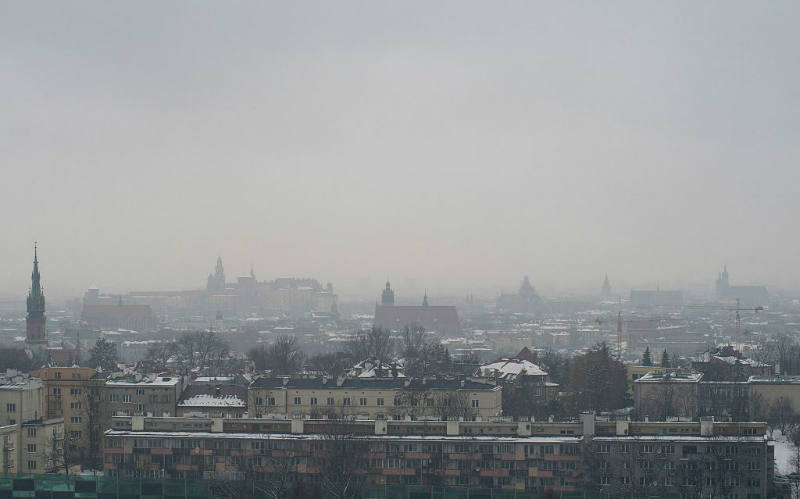

Polish environmental and health organizations have asked for better information about air pollution, noting that the alert threshold for particulate matter is set at six times the World Health Organization’s maximum limit.
Environmental groups estimate that around 47,000 people die in Poland each year as a result of illnesses caused by air pollution.
The WHO notes that even small concentrations of particulate matter can have significant health effects.
Particulate matter (PM) is described by the World Health Organization as “a complex mixture of solid and liquid particles of organic and inorganic substances suspended in the air.”
The Polish organizations wrote: “Despite the seriousness of the air pollution problems facing Poland as well as the resulting threats to public health, the PM10 level at which information is provided [to the public] in our country is currently set at 200 micrograms per cubic metre.”
The WHO’s recommended maximum 24-hour mean is 50 micrograms per cubic metre, which means that information in Poland is provided only once air pollution is four times greater.
In addition Poland’s alert threshold is 300 micrograms per cubic metre, six times higher than the WHO’s limit.
Signatories to the appeal, targeted at the country’s Ministry of Environment, include Greenpeace, the Polish Society of Lung Diseases, the Polish Cardiac Society, the Polish Cancer League and the Polish Neonatal Society.
The signatory organizations noted that the thresholds at which information and alerts are provided are lower in other EU countries.
In Hungary information is provided at a level of 75 micrograms per cubic metre, while an alert is issued at 100 micrograms per cubic metre.
Professor Piotr Hoffman, head of the Polish Cardiac Society, said that on days of high air pollution “mortality increases… It is therefore important for the people most at risk to know about elevated levels of air pollution.”